How do you determine the direction of
the initial velocity from a y vs x graph?
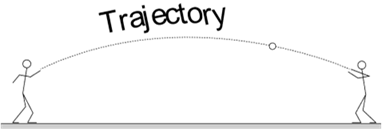
Imagine watching a friend
throw a ball to another friend as shown in the diagram below.� Because of gravity, the ball doesn�t follow a
straight line.� In fact, if the drag
force from air can be ignored, then the ball follows a path that is shaped like
a parabola.� This parabolic path is
called the �trajectory� of the ball.�
Now compare the
trajectory in the diagram above to the y vs x graph for the same ball that is
shown below.�

They appear to be
identical because they are.� Both
represent a plot of the vertical coordinate y vs the horizontal coordinate x of
the ball.� In short, a y vs x graph of a
motion is identical to the trajectory in a photograph of that motion.�
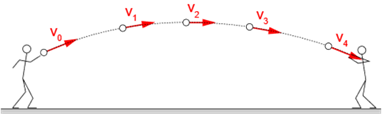
The diagram below is
identical to the one above, but this time, the ball is shown at five different
instants as it moves along its trajectory.�
A velocity vector has also been drawn at each of these five
instants.� The directions of these
velocity vectors indicate the direction the ball is moving at each
instant.� Notice that each of the
velocity vector is tangent to the trajectory.�
The reason you chose to
read this blurb of text is to answer the question:
�������� �How do you determine the direction of the initial
velocity?�
The initial velocity has
the same direction as the vector that is tangent to the trajectory at the
initial location of the ball!� In the
diagram above, the initial location is the instant the ball leaves the person�s
hand.� Hence, the vector labeled �v0�
in the diagram is the initial velocity.� In
the simulation, the initial location is indicated by the data point that has a
black border and is slightly larger than the other data points.� Hence, to determine the direction of the
initial velocity, simply determine the direction that is tangent to the
trajectory at that point.�