How do you determine the direction of
the acceleration?
Imagine watching a friend
throw a ball to another friend as shown in the diagram below.� Because of gravity, the ball doesn�t follow a
straight line.� In fact, if the drag from
air can be ignored, then the ball follows a path that is shaped like a
parabola.� This parabolic path is called
the �trajectory� of the ball.�
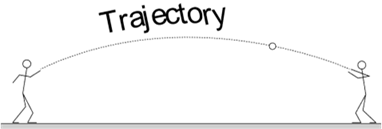
Now compare the
trajectory in the diagram above to the y vs x graph for the same ball that is
shown below.�
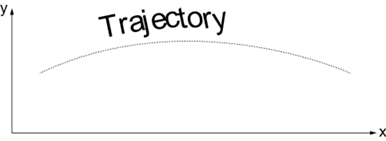
They appear to be
identical because they are.� Both
represent a plot of the vertical coordinate y vs the horizontal coordinate x of
the ball.� In short, a y vs x graph of a
motion is identical to the trajectory in a photograph of that motion.�
The acceleration in the
ball-throwing example above is constant and is the earth�s freefall
acceleration.� Its direction is straight
down.� All of the accelerations in this
simulation are also constant so result in parabolically shaped trajectories.� The direction of such accelerations will
always be in the direction that the parabola opens.�
One difficulty that you
will likely encounter is that the y vs x graphs that you see may only show a
portion of a parabola, not the entire parabola.�
The portion that is displayed may not even include the vertex of the
parabola.� In such cases, it is more difficult
to determine the exact direction in which the parabola opens.� Keep in mind, however that the component of
the velocity perpendicular to the acceleration will be constant.� For example, if the acceleration points
vertically, then the horizontal spacing between the data points will be
uniform.� If the acceleration points
diagonally, then the data points will be spaced uniformly in the direction of
the opposite diagonal.� Hence, if it is
difficult to determine the direction in which the parabola opens, try to
determine the direction in which the data points are uniformly spaced.�