The definition of average velocity is:

According to this definition, the vector average velocity is
obtained by dividing a vector by a scalar.� Since the scalar ( ) is always positive,
this definition indicates that the two vectors (
) is always positive,
this definition indicates that the two vectors ( �and
�and  ) have the same
direction.� We would like to apply this definition to find the velocity at the
turning point.� Then �and �in the definition
correspond to an interval that spans the turning point, i.e., with an initial
point just before the turning point and with a final point just after the
turning point.� The diagrams below illustrate this idea graphically for a ball
that is turning around.
) have the same
direction.� We would like to apply this definition to find the velocity at the
turning point.� Then �and �in the definition
correspond to an interval that spans the turning point, i.e., with an initial
point just before the turning point and with a final point just after the
turning point.� The diagrams below illustrate this idea graphically for a ball
that is turning around.
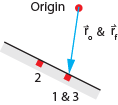 Suppose
a ball rolls uphill past point 1, turns around at point 2 and then rolls
downhill past point 3.� Since the ball has turned around, points 1 and 3
correspond to the same location.� The position of the ball is a vector that
points from the origin to the location of the ball.� The location of the origin
in the diagram is arbitrary.� Its location will not affect the velocity we are
trying to compute.� Since points 1 and 3 represent the same point, the position
vectors at these two instants are also the same.� If this is true, what is ?� What is ?
Suppose
a ball rolls uphill past point 1, turns around at point 2 and then rolls
downhill past point 3.� Since the ball has turned around, points 1 and 3
correspond to the same location.� The position of the ball is a vector that
points from the origin to the location of the ball.� The location of the origin
in the diagram is arbitrary.� Its location will not affect the velocity we are
trying to compute.� Since points 1 and 3 represent the same point, the position
vectors at these two instants are also the same.� If this is true, what is ?� What is ?