The definition of average acceleration is:

According to this definition, the vector average
acceleration is obtained by dividing a vector by a scalar.� Since the scalar ( )
is always positive, this definition indicates that the two vectors (
)
is always positive, this definition indicates that the two vectors ( �and
�and
 )
have the same direction.� We would like to apply this definition to find the
direction of the acceleration at point D.� Then �and
�in
the definition correspond to an interval that spans point D, i.e., an interval with an initial point just before
point D and with a final point just after point D.� The diagrams below illustrate this idea
graphically.
)
have the same direction.� We would like to apply this definition to find the
direction of the acceleration at point D.� Then �and
�in
the definition correspond to an interval that spans point D, i.e., an interval with an initial point just before
point D and with a final point just after point D.� The diagrams below illustrate this idea
graphically.
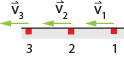 Suppose
that a ball rolls along a straight and level track from point 1 to 2 to 3.� Assume
that the ball rolls at constant speed.� Hence the lengths of the velocity
arrows are all the same.�
Suppose
that a ball rolls along a straight and level track from point 1 to 2 to 3.� Assume
that the ball rolls at constant speed.� Hence the lengths of the velocity
arrows are all the same.�
���������������������������������������������������������
Recall that the change in velocity between the final point (point 3) and the initial point (point 1) is:
 .
.
Since, the ball is rolling with constant velocity,  �and
�and
 �are
equal.� Hence, �equals
zero.� In addition, the definition of acceleration implies that the
acceleration must be zero as well.�
�are
equal.� Hence, �equals
zero.� In addition, the definition of acceleration implies that the
acceleration must be zero as well.�
In summary, the acceleration will be zero whenever an object moves with constant speed in a straight line.�